maximum test » Philip "Philip King of Duitsland (Geni Tree Match) Too ..." Hohenstaufen King of Duitsland (1176-1208)
Persönliche Daten Philip "Philip King of Duitsland (Geni Tree Match) Too ..." Hohenstaufen King of Duitsland
Quellen 1, 2, 3, 4- Spitzname ist Philip King of Duitsland (Geni Tree Match) Too ....
- Er wurde geboren im Jahr 1176Schwaben Deutschland(HRR).
- Er wurde getauft im Jahr 1190 in Tuscany, Firenze, Italy.
- Alternative: Er wurde getauft in Schwaben, Bayern Lande, Duitsland.
- Fetauft (im Alter von 8 Jahren oder später) von der Priestertumsvollmacht der HLT-Kirche .
- Alternative: Fetauft (im Alter von 8 Jahren oder später) von der Priestertumsvollmacht der HLT-Kirche am 30. November 1993 in PROVO.
- Berufe:
- Konung av.
- Évêque, de Würzburg, 1191, Marquis, de Toscane, 1195, Duc, de Souabe, 1196, Roi.
- Er ist verstorben am 21. Juni 1208, er war 32 Jahre altBamberg
Bavaria Duitsland. - Er wurde beerdigt im Jahr 1208 in Speyer CathedralSpeyer
Rheinland-Pfalz Duitsland. - Ein Kind von Friedrich I "Barbarossa" von Hohenstaufen und Beatrice de Borgoña
- Diese Information wurde zuletzt aktualisiert am 15. Januar 2020.
Familie von Philip "Philip King of Duitsland (Geni Tree Match) Too ..." Hohenstaufen King of Duitsland
Er ist verheiratet mit Irini Maria Άγγελος.
Sie haben geheiratet im Jahr 1197, er war 21 Jahre alt.
Kind(er):
Notizen bei Philip "Philip King of Duitsland (Geni Tree Match) Too ..." Hohenstaufen King of Duitsland
(Research):Philip of Swabia Philip of Swabia Pronounced As: swab , 1176?-1208, German king (1198-1208), son of Holy Roman Emperor Frederick I. After the death (1197) of his brother, German King and Holy Roman Emperor Henry VI, he unsuccessfully attempted to secure the succession in Duitsland of his infant nephew, the later Holy Roman Emperor Frederick II; for the sake of the house of Hohenstaufen, he finally consented to his own election as German king. A small, anti-Hohenstaufen group led by the archbishop of Keulen elected (1198) Otto IV antiking. In the ensuing war Philip was supported by Philip II of France, while Otto had the support of his uncle Richard I of England. Though successful at first, Philip's cause was weakened when Pope Innocent III declared (1201) for Otto. However, the year 1204 marked a turn in Philip's favor; with his capture (1206) of Keulen, the war was virtually ended. Negotiations with the pope had resulted in a satisfactory settlement when Philip was murdered by a personal enemy. Otto IV was elected his successor as German king. Philip became involved in the Fourth Crusade (1202-4; see Crusades) partly through his marriage to the Byzantine princess Irene, daughter of Emperor Isaac II. The extent of Philip's influence in diverting the crusade to Constantinople is still debated. Philip Encyclopædia Britannica Article born 1178 died June 21, 1208, Bamberg, Ger. also called Philip Of Swabia, German Philipp Von Schwaben German Hohenstaufen king whose rivalry for the crown involved him in a decade of warfare with the Welf Otto IV. The youngest son of the Holy Roman emperor Frederick I Barbarossa, Philip was destined for the church. After being provost of the cathedral at Aachen, he was, in 1190 or 1191, elected bishop of Würzburg. Shortly after the death of his brother Frederick (1191), however, he abandoned his ecclesiastical career. Another brother, the Holy Roman emperor Henry VI, made him duke of Tuscany in 1195 and duke of Swabia in 1196. In May 1197 he married Irene, daughter of the Byzantine emperor Isaac II Angelus. At Henry VI's death in September 1197, his son, the future emperor Frederick II, was less than three years old, and the German princes were unwilling to accept him as king. The princes favourable to the Hohenstaufens elected Philip German king in March 1198. The opposing party, led by Archbishop Adolf of Keulen, elected Otto, a son of Henry the Lion of Brunswick of the rival Welf dynasty, king in June of that year. Otto was crowned at Aachen, the proper place for the ceremony, by Archbishop Adolf. Philip's coronation, by another prelate, did not take place until September 1198 at Mainz. In the ensuing civil war the Hohenstaufen cause prospered at first. In 1201, however, Pope Innocent III recognized Otto as king and excommunicated Philip. Philip's fortunes were only restored in 1204, by a series of defections from Otto's side, culminating in that of Adolf of Keulen himself. In June 1205, Adolf crowned Philip at Aachen. The city of Keulen, which, notwithstanding its archbishop, had sided with Otto, was captured in January 1207, and Otto's cause seemed lost. Late in 1207, however, when Philip offered to give Otto one of his daughters in marriage and to enfeoff him with either the duchy of Swabia or the kingdom of Arles, Otto, buoyed by hopes of financial, if not military, support from the kings of England and Denmark, rejected the offer. Nevertheless, a truce was arranged that lasted until June of the following year. In 1208 Pope Innocent III recognized Philip as king and promised to crown him emperor. Philip, who had mobilized his army at Bamberg in order to move against Otto, was waiting for the truce to expire when he was murdered by Otto of Wittelsbach, count Palatine of Bavaria, to whom he had refused to give one of his daughters in marriage. Eventually his daughters were married: Beatrix the Elder to his old rival Otto, Cunigunda to King Wenceslas of Bohemia, and Beatrix the Younger to Ferdinand III of Castile. A brave man, Philip was praised by contemporaries for his mildness and generosity. The diversion of the Fourth Crusade to Constantinople is assumed by some authorities to have been prompted by him in the interests of his brother-in-law, the Byzantine emperor Alexius IV Angelus.
Name Suffix:Holy Roman Emperor
He was bishop of Wurzburg and destined for the church, but after the death of
his brother Frederick in 1191, he abandoned his ecclesiastical career.
Another brother, Emperor Henry VI, made him Duke of Swabia in 1196 and Duke
of Tuscany in 1195. After brother Henry died in 1197, the heir was only three
years old (Frederick II), and Philip was elected as King to succeed his
brother. Civil was ensued, for Otto, a son of Henry the Lion was also elected
that same year. While mobilizing his army, Philip was murdered at Bamberg.
Philip of Swabia
From Wikipedia, the free encyclopedia
Philip of Swabia depicted in a medieval manuscript (about 1200).Philip of Swabia (1177 – June 21, 1208) was king of Duitsland and duke of Swabia, the rival of the emperor Otto IV.
Contents [hide]
1 Biography
2 Ancestors
3 References
4 Philip's descendants
5 See also
6 External links
[edit] Biography
Philip was the fifth and youngest son of the emperor Frederick I and Beatrix, daughter of Renaud III, count of Burgundy, and brother of the emperor Henry VI. He entered the clergy, was made provost of Aix-la-Chapelle, and in 1190 or 1191 was chosen bishop of Würzburg. Having accompanied his brother Henry to Italy in 1191, Philip forsook his ecclesiastical calling, and, travelling again to Italy, was made duke of Tuscany in 1195 and received an extensive grant of lands. In 1196 he became duke of Swabia, on the death of his brother Conrad; and in May 1197 he married Irene Angelina, daughter of the Byzantine emperor, Isaac II, and widow of Roger III, Titular King of Sicily, a lady who is described by Walther von der Vogelweide as " the rose without a thorn, the dove without guile."
Philip enjoyed his brother's confidence to a very great extent, and appears to have been designated as guardian of the Henry's young son Frederick, afterwards the emperor Frederick II, in case of his father's early death. In 1197 he had set out to fetch Frederick from Sicily for his coronation as King of the Germans when he heard of the emperor's death and returned at once to Duitsland. He appears to have desired to protect the interests of his nephew and to quell the disorder which arose on Henry's death, but was overtaken by events. The hostility to the kingship of a child was growing, and after Philip had been chosen as defender of the empire during Frederick's minority he consented to his own election. He was elected German king at Mühlhausen on March 8, 1198, and was crowned at Mainz on the September 8 following.
Meanwhile, a number of princes hostile to Philip, under the leadership of Adolph, Archbishop of Keulen, had elected an anti-king in the person of Otto, second son of Henry the Lion, duke of Saxony. In the war that followed, Philip, who drew his principal support from south Duitsland, met with considerable success. In 1199 he received further accessions to his party and carried the war into his opponent's territory, although unable to obtain the support of Pope Innocent III, and only feebly assisted by his ally Philip Augustus, king of France. The following year was less favourable to his arms; and in March 1201 Innocent took the decisive step of placing Philip and his associates under the ban, and began to work energetically in favour of Otto.
Also in 1201, Philip was visited by his cousin Boniface of Montferrat, the leader of the Fourth Crusade. The Crusaders were by this time under Venetian control and were besieging Zara on the Adriatic Sea. Although Boniface's exact reasons for meeting with Philip are unknown, while at Philip's court he also met Alexius Angelus, Philip's brother-in-law. Alexius convinced Boniface, and later the Venetians, to divert the Crusade to Constantinople and restore Isaac II to the throne, as he had recently been deposed by Alexius III, Alexius and Irene's uncle.
The two succeeding years were still more unfavourable to Philip. Otto, aided by Ottokar I, king of Bohemia, and Hermann I, landgrave of Thuringia, drove him from north Duitsland, thus compelling him to seek by abject concessions, but without success, reconciliation with Innocent. The submission to Philip of Hermann of Thuringia in 1204 marks the turning-point of his fortunes, and he was soon joined by Adolph of Keulen and Henry I, Duke of Brabant.
On January 6, 1205 he was crowned again with great ceremony by Adolph at Aix-la-Chapelle, though it was not till 1207 that his entry into Keulen practically brought the war to a close. A month or two later Philip was loosed from the papal ban, and in March 1208 it seems probable that a treaty was concluded by which a nephew of the pope was to marry one of Philip's daughters and to receive the disputed dukedom of Tuscany. Philip was preparing to crush the last flicker of the rebellion in Brunswick-Lüneburg when he was murdered at Bamberg, on June 21, 1208, by Otto of Wittelsbach, count palatine in Bavaria, to whom he had refused the hand of one of his daughters. Philip was a brave and handsome man, and contemporary writers, among whom was Walther von der Vogelweide, praise his mildness and generosity.
[edit] Ancestors
Philip's ancestors in three generations Philip of Swabia Father:
Frederick I, Holy Roman Emperor Paternal Grandfather:
Frederick II, Duke of Swabia Paternal Great-grandfather:
Frederick I, Duke of Swabia
Paternal Great-grandmother:
Agnes of Duitsland
Paternal Grandmother:
Judith Paternal Great-grandfather:
Henry IX, Duke of Bavaria
Paternal Great-grandmother:
Wulfhild of Saxony
Mother:
Beatrice I, Countess of Burgundy Maternal Grandfather:
Renaud III, Count of Burgundy Maternal Great-grandfather:
Stephen I, Count of Burgundy
Maternal Great-grandmother:
Beatrix of Lorraine
Maternal Grandmother:
Agatha Maternal Great-grandfather:
Simon I, Duke of Lorraine
Maternal Great-grandmother:
Adelaide
[edit] References
Peter Csendes, Philipp von Schwaben. Ein Staufer im Kampf um die Macht, 2003.
This article incorporates text from the Encyclopædia Britannica Eleventh Edition article "Philip", a publication now in the public domain.
[edit] Philip's descendants
Philip of Swabia married Irene Angelina, daughter of Isaac II Angelus on May 25, 1197. Their four daughters were:
Beatrice of Hohenstaufen (1198-1212), married Otto IV, Holy Roman Emper
Cunigunde of Hohenstaufen (1200-1248), married King Wenceslaus I, King of Bohemia
Mary of Hohenstaufen (1201-1235), married Henry II, Duke of Brabant
Elisabeth of Hohenstaufen (1203-1235), married King Ferdinand III of Castile
[edit] See also
Dukes of Swabia family tree
[edit] External links
Philip of Swabia; The Columbia Encyclopedia, Sixth Edition
Philip (of Swabia) -- Encyclopedia Britannica
Philipp von Schwaben
Preceded by
Henry VI King of Duitsland
(formally King of the Romans)
1198–1208
(contested by Otto IV) Succeeded by
Otto IV
Preceded by
Conrad II Hohenstaufen Duke of Swabia
1196–1208 Succeeded by
Frederick VI
He was bishop of Wurzburg and destined for the church, but after the death of
his brother Frederick in 1191, he abandoned his ecclesiastical career.
Another brother, Emperor Henry VI, made him Duke of Swabia in 1196 and Duke
of Tuscany in 1195. After brother Henry died in 1197, the heir was only three
years old (Frederick II), and Philip was elected as King to succeed his
brother. Civil was ensued, for Otto, a son of Henry the Lion was also elected
that same year. While mobilizing his army, Philip was murdered at Bamberg.
He was bishop of Wurzburg and destined for the church, but after the death of
his brother Frederick in 1191, he abandoned his ecclesiastical career.
Another brother, Emperor Henry VI, made him Duke of Swabia in 1196 and Duke
of Tuscany in 1195. After brother Henry died in 1197, the heir was only three
years old (Frederick II), and Philip was elected as King to succeed his
brother. Civil was ensued, for Otto, a son of Henry the Lion was also elected
that same year. While mobilizing his army, Philip was murdered at Bamberg.
He was bishop of Wurzburg and destined for the church, but after the death of
his brother Frederick in 1191, he abandoned his ecclesiastical career.
Another brother, Emperor Henry VI, made him Duke of Swabia in 1196 and Duke
of Tuscany in 1195. After brother Henry died in 1197, the heir was only three
years old (Frederick II), and Philip was elected as King to succeed his
brother. Civil was ensued, for Otto, a son of Henry the Lion was also elected
that same year. While mobilizing his army, Philip was murdered at Bamberg.
[alfred_descendants10gen_fromrootsweb_bartont.FTW]
Duke of Swabia; Margrave of Tuscany, Emperor of Duitsland, 1198; m. Irene Angelica, dau. of Isaac II Angelus. (CCN 802. Generations 21-27; Thatcher 322; G.P. Fisher, op. cit. 259). Weis 45-27.
16. Frederick von Büren
8. Frederick I, Duke of Swabia
17. Hildegard von Bar-Mousson
4. Frederick II, Duke of Swabia
18. Henry IV, Holy Roman Emperor
9. Agnes of Duitsland
19. Bertha of Savoy
2. Frederick I, Holy Roman Emperor
20. Welf I, Duke of Bavaria
10. Henry IX, Duke of Bavaria
21. Judith of Flanders
5. Judith of Bavaria
22. Magnus, Duke of Saxony
11. Wulfhild of Saxony
23. Sophia of Hungary
1. Philip of Swabia
24. William I, Count of Bourgogne
12. Stephen I, Count of Bourgogne
25. Stephanie
6. Renaud III, Count of Bourgogne
13. Beatrix of Lorraine
3. Beatrice I, Countess of Bourgogne
28. Theodoric II, Duke of Lorraine
14. Simon I, Duke of Lorraine
29. Hedwige of Formbach
7. Agatha of Lorraine
30. Henry III of Leuven
15. Adelaide of Leuven
31. Gertrude of Flanders
[edit]
See also
Fought for crown 10 years, died before crowning by Pope.
Phillip II, son by (2), b. 1177/81, murdered at Bamberg by Otto of Wittelsbach, 21 June 1208, Duke of Swabia, Margrave of Tuscany, Emperor of Duitsland, 1198; m. 1196, Irene Angelica, daughter of Isaac II Angelus, d. 1204, Eastern Roman Emperor, son of Andronicus Angelus (m. Euphrosyne Castamonita), son of Theodora Comnena (m. Constantinus Angelus), daughter of Alexis I, Comnenus, b. 1048, d. 15 Aug 1118, Emperor of the East, who m. c 1078, Irene, daughter of Andonicus Ducas, by wife Maria, daughter of Trojan of Bulgaria, son of Samuel, d. 1014, King of Bulgaria. [Ancestral Roots, line 45-27]
Philip of Swabia (1177-1208) was king of Duitsland and duke of Swabia, t he rival of the emperor Otto IV. He was the fifth and youngest son o f the emperor Frederick I and Beatrix, daughter of Renaud III, count o f Burgundy, and consequently brother of the emperor Henry VI. He enter ed the clergy, was made provost ofAix-la-Chapelle, and in 1190 or 119 1 was chosen bishop of Würzburg. Having accompanied his brother Henry to Italy in 1191, Philip forsook his ecclesiastical calling, and, trav elling again to Italy, was made duke of Tuscany in 1195 and received a n extensive grant of lands. In 1196 he became duke of Swabia, on the d eath of his brother Conrad; and in May 1197 he married Irene Angelina , daughter of the Byzantine emperor, Isaac II, and widow of Roger III , Titular King of Sicily, a lady who is described by Walther von der V ogelweide as " the rose without a thorn, the dove without guile."
Philip enjoyed his brother's confidence to a very great extent, and ap pears to have been designated as guardian of the young Frederick, afte rwards the emperor Frederick II, in case of his father's early death.I n 1197 he had set out to fetch Frederick from Sicily for his coronatio n when he heard of the emperor's death and returned at once to Duitsland . He appears to have desired to protect the interests of his nephew an d to quell the disorder which arose on Henry's death, but events were too strong for him. The hostility to the kingship of a child was growi ng, and after Philip had been chosen as defender of the empire during Frederick's minority he consented to his own election. He was elected German king at Muhlhausen on March 8, 1198 with the support of Phillip pe of France, and crowned at Mainz on the following September 8th. I n 1198, as the heir of his brother Henry's estate, Phillipp was obliga ted by the Pope to refund the ransom money that had been collected by Henry for the ransom of Richard I.
Meanwhile a number of princes hostile to Philip, under the leadershipo f Adolph, Archbishop of Keulen, had elected an anti-king in the perso n of Otto, second son of Henry the Lion, duke of Saxony. In the war th at followed, Philip, who drew his principal support from south Duitsland , met with considerable success. In 1199 he received further accessio ns to his party and carried the war into his opponent's territory, alt hough unable to obtain the support of Pope Innocent III, and only feeb ly assisted by his ally Philip Augustus, king of France. The followin g year was less favourable to his arms; and in March 1201 Innocent too k the decisive step of placing Philip and his associates under the ban , and began to work energetically in favour of Otto.
Also in 1201, Philip was visited by his cousin Boniface of Montferrat , the leader of the Fourth Crusade. The Crusaders were by this time un der Venetian control and were besieging Zara on the Adriatic Sea. Alth ough Boniface's exact reasons for meeting with Philip are unknown, whi le at Philip's court he also met Alexius Angelus, Philip's brother-in- law. Alexius convinced Boniface, and later the Venetians, to divert th e Crusade to Constantinople and restore Isaac II to the throne, as heh ad recently been deposed by Alexius III, Alexius and Irene's uncle.
The two succeeding years were still more unfavourable to Philip. Otto , aided by Ottokar I, king of Bohemia, and Hermann I, landgrave of Thu ringia, drove him from north Duitsland, thus compelling him to seek by a bject concessions, but without success, reconciliation with Innocent.T he submission to Philip of Hermann of Thuringia in 1204 marks the turn ing-point of his fortunes, and he was soon joined by Adolph of Cologn e and Henry I, Duke of Brabant.
On January 6, 1205 he was crowned again with great ceremony by Adolpha t Aix-la-Chapelle, though it was not till 1207 that his entry into Col ogne practically brought the war to a close. A month or two later Phil ip was loosed from the papal ban, and in March 1208 it seems probable that a treaty was concluded by which a nephew of the pope was to marr y one of Philip's daughters and to receive the disputed dukedom of Tus cany. Philip was preparing to crush the last flicker of the rebellion in Brunswick-Lüneburg when he was murdered at Bamberg, on June 21, 120 8, by Otto of Wittelsbach, count palatine in Bavaria, to whom he had r efused the hand of one of his daughters. Philip was a brave and handso me man, and contemporary writers, among whom was Walther von der Vogel weide, praise his mildness and generosity.
{geni:about_me} Philipp von Schwaben
==Links:==
*[http://thepeerage.com/p11427.htm#i114270 The Peerage]
*[http://www.geneall.net/D/per_page.php?id=7704 Geneall]
*[http://en.wikipedia.org/wiki/Philip_of_Swabia Wikipedia]
*'''King of Duitsland(formally King of the Romans):''' Reign: 1198–1208 (contested by Otto IV)
>'''Predecessor:''' [http://www.geni.com/people/Heinrich-VI-Holy-Roman-Emperor/6000000003614102983 Henry VI] '''Successor:''' [http://www.geni.com/people/Otto-IV-Holy-Roman-Emperor/6000000000107264196 Otto IV]
*'''Duke of Swabia:''' Reign 1196–1208
>'''Predecessor:''' [http://www.geneall.net/D/per_page.php?id=7702 Conrad II] '''Successor:''' [http://www.geni.com/people/Friedrich-II-von-Hohenstaufen-Kaiser-des-Heiligen-r%C3%B6misch-deutschen-Reiches/6000000000424888017 Frederick VI]
[FAVthomas.FTW]
Duke of Swabia, Margrave of Tuscany, Emperor of Duitsland 1198. Murdered byOtto of Wittelsbach.
king of Duitsland and duke of Swabia
Emperador Germánico (1205-1208)
Emperador Germánico (1205-1208)
ES I:5 PED OF A.H.AYERS
Heir to the Hohenstauffen house of Swabia. Marriage arranged to dtr of Isaac II Angelus Emperor of the Byzantine Empire. Philip is a brother to Holy Roman Emperor Henry VI, who arranged the marriage. Philip II of Swabia, youngest son of Frederick I the Barbarossa, of the house of Hohenstaufen, had been educated for the church, but resigned his "see" in 1192. Phillip of Swabia, of the house of Hohenstaufen, son of Frederick I the Barbarossa, succeeded his brother Henry VI as Emperor of Duitsland in 1197. He ruled until 1208, and was succeeded by Otto IV of Saxony, his son-in-law.
Philipp_von_Schwaben_1200
http://trees.ancestry.com/rd?f=image&guid=cc76f5f4-fb95-41a0-b4d5-7c4e4c070048&tid=6959821&pid=-1150507265
Philipp_von_Schwaben_1200
http://trees.ancestry.com/rd?f=image&guid=cc76f5f4-fb95-41a0-b4d5-7c4e4c070048&tid=6959821&pid=-1150507265
Heir to the German Kingdom
http://trees.ancestry.com/rd?f=document&guid=438ad233-db82-464b-94e4-359312a0d9a4&tid=6959821&pid=-1168345959
Heir to the German Kingdom
http://trees.ancestry.com/rd?f=document&guid=438ad233-db82-464b-94e4-359312a0d9a4&tid=6959821&pid=-1168345959
"OF SWABIA"; KING OF Duitsland 1198-1208
DUKE OF SWABIA; KING OF Duitsland
Zeitbalken Philip "Philip King of Duitsland (Geni Tree Match) Too ..." Hohenstaufen King of Duitsland
Diese Funktionalität ist Browsern mit aktivierten Javascript vorbehalten.
Klicken Sie auf den Namen für weitere Informationen.
Verwendete Symbole:  Großeltern
 Eltern
 Geschwister
 Kinder
Großeltern
Eltern
Geschwister
Kinder
Vorfahren (und Nachkommen) von Philip Hohenstaufen
Philip Hohenstaufen 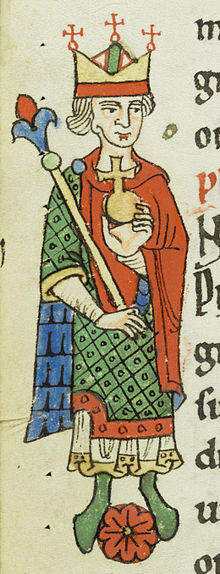 | ||||||||||||||||||||||||||||||||||
1197 | ||||||||||||||||||||||||||||||||||
Irini Maria Άγγελος  | ||||||||||||||||||||||||||||||||||
Quellen
Anknüpfungspunkte in anderen Publikationen
Diese Person kommt auch in der Publikation vor: Alle Übereinstim-
Historische Ereignisse
Taufdatum 30. November 1993
- Die Temperatur am 30. November 1993 lag zwischen -4,7 °C und -1,0 °C und war durchschnittlich -2,8 °C. Es gab 3,0 mm Niederschlag während der letzten 8,2 Stunden. Es war fast komplett bewölkt. Die durchschnittliche Windgeschwindigkeit war 3 Bft (mäßiger Wind) und kam überwiegend aus Süd-Osten. Quelle: KNMI
- Koningin Beatrix (Huis van Oranje-Nassau) war von 30. April 1980 bis 30. April 2013 Fürst der Niederlande (auch Koninkrijk der Nederlanden genannt)
- Von Dienstag, 7 November, 1989 bis Montag, 22 August, 1994 regierte in den Niederlanden das Kabinett Lubbers III mit Drs. R.F.M. Lubbers (CDA) als ersten Minister.
- Im Jahr 1993: Quelle: Wikipedia
- Die Niederlande hatte ungefähr 15,2 Millionen Einwohner.
- 14. Februar » Die internationale Vereinigung Euroregion Karpaten wird in Debrecen von vier Staaten gegründet.
- 20. März » Der Profiboxer Henry Maske aus Frankfurt (Oder) gewinnt durch einen Punktsieg gegen den US-Amerikaner Charles Williams die Weltmeisterschaft im Halbschwergewicht.
- 23. Juli » Im Konflikt um Bergkarabach erobern und zerstören armenische Streitkräfte die aserbaidschanische Stadt Aghdam.
- 28. August » Während des Bosnienkriegs rufen bosnisch-herzegowinische Kroaten die Republik Herceg-Bosna aus und bestimmen Mate Boban zu deren Präsidenten. Internationale Anerkennung bleibt diesem Staat versagt.
- 11. November » Die Version 1.0 des Webbrowsers NCSA Mosaic, für Microsoft Windows, wird veröffentlicht.
- 1. Dezember » Der deutsche Musikfernsehsender VIVA nimmt den Sendebetrieb auf.
Sterbedatum 21. Juni 1208
- Graaf Willem I (Hollands Huis) war von 1203 bis 1222 Fürst der Niederlande (auch Graafschap Holland genannt)
Gleicher Geburts-/Todestag
- 1126 » Raimund von Roda, Bischof von Roda de Isábena und Barbastro
- 1200 » Anastasija Srpska, serbisch-orthodoxe Heilige
- 1208 » Philipp von Schwaben, Herzog von Schwaben und deutscher König
- 1221 » Heinrich III., Herzog von Limburg und Graf von Arlon
- 1259 » Otto II. von Lippe, Bischof von Münster
- 1305 » Wenzel II., König von Böhmen, Herzog von Krakau und König von Polen
Über den Familiennamen Hohenstaufen
- Zeigen Sie die Informationen an, über die Genealogie Online verfügt über den Nachnamen Hohenstaufen.
- Überprüfen Sie die Informationen, die Open Archives hat über Hohenstaufen.
- Überprüfen Sie im Register Wie (onder)zoekt wie?, wer den Familiennamen Hohenstaufen (unter)sucht.
Die maximum test-Veröffentlichung wurde von Ard van Bergen erstellt.
Geben Sie beim Kopieren von Daten aus diesem Stammbaum bitte die Herkunft an:
Ard van Bergen, "maximum test", Datenbank, Genealogie Online (https://www.genealogieonline.nl/maximum-test/I5020155500120110724.php : abgerufen 31. Januar 2026), "Philip "Philip King of Duitsland (Geni Tree Match) Too ..." Hohenstaufen King of Duitsland (1176-1208)".
Ard van Bergen, "maximum test", Datenbank, Genealogie Online (https://www.genealogieonline.nl/maximum-test/I5020155500120110724.php : abgerufen 31. Januar 2026), "Philip "Philip King of Duitsland (Geni Tree Match) Too ..." Hohenstaufen King of Duitsland (1176-1208)".