Family tree Lobé en verwanten. » Hendricus Theodorus Victor van der Valk (1910-1991)
Personal data Hendricus Theodorus Victor van der Valk
Source 1- He was born on July 27, 1910 in Kwintsheul, Wateringen.
- He died on July 21, 1991 in Delft, he was 80 years old.
- A child of Johannes Adrianus van der Valk and Hillegonda Petronella (Gon) Reincke
Household of Hendricus Theodorus Victor van der Valk
He is married to Margaretha Prudentia Clarita (Greet) Schreuder.
They got married on March 24, 1944 at Naaldwijk, he was 33 years old.
Child(ren):
Timeline Hendricus Theodorus Victor van der Valk
This functionality is only available in Javascript supporting browsers.
Click on the names for more info.
Symbols used:  grandparents
 parents
 brothers/sisters
 children
grandparents
parents
brothers/sisters
children
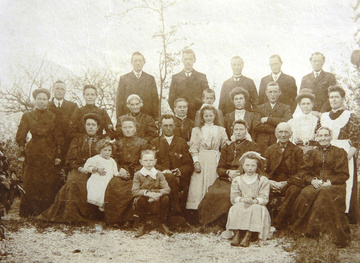
Image(s) Hendricus Theodorus Victor van der Valk


Ancestors (and descendant) of Hendricus Theodorus Victor van der Valk
Hendricus Theodorus Victor van der Valk  | ||||||||||||||||||||||||||||||||||
1944 | ||||||||||||||||||||||||||||||||||
Sources
- (Not public)
Matches in other publications
This person also appears in the publication: View all
Historical events
Birthday July 27, 1910
- The temperature on July 27, 1910 was between 11.8 °C and 19.3 °C and averaged 15.2 °C. There was 6.0 hours of sunshine (38%). The average windspeed was 3 Bft (moderate breeze) and was prevailing from the west-southwest. Source: KNMI
- Koningin Wilhelmina (Huis van Oranje-Nassau) was from 1890 till 1948 sovereign of the Netherlands (also known as Koninkrijk der Nederlanden)
- In The Netherlands , there was from February 12, 1908 to August 29, 1913 the cabinet Heemskerk, with Mr. Th. Heemskerk (AR) as prime minister.
- In the year 1910: Source: Wikipedia
- The Netherlands had about 5.9 million citizens.
- January 1 » Captain David Beatty is promoted to Rear admiral, and becomes the youngest admiral in the Royal Navy (except for Royal family members) since Horatio Nelson.
- January 15 » Construction ends on the Buffalo Bill Dam in Wyoming, United States, which was the highest dam in the world at the time, at 325ft (99m).
- March 3 » Rockefeller Foundation: John D. Rockefeller Jr. announces his retirement from managing his businesses so that he can devote all his time to philanthropy.
- August 29 » The Japan–Korea Treaty of 1910, also known as the Japan–Korea Annexation Treaty, becomes effective, officially starting the period of Japanese rule in Korea.
- October 1 » A large bomb destroys the Los Angeles Times building, killing 21.
- November 23 » Johan Alfred Ander becomes the last person to be executed in Sweden.
Day of marriage March 24, 1944
- The temperature on March 24, 1944 was between 2.5 °C and 10.7 °C and averaged 6.1 °C. There was 0.3 mm of rain during 0.6 hours. There was 4.3 hours of sunshine (35%). The average windspeed was 4 Bft (moderate breeze) and was prevailing from the northwest. Source: KNMI
- Koningin Wilhelmina (Huis van Oranje-Nassau) was from 1890 till 1948 sovereign of the Netherlands (also known as Koninkrijk der Nederlanden)
- In The Netherlands , there was from July 27, 1941 to February 23, 1945 the cabinet Gerbrandy II, with Prof. dr. P.S. Gerbrandy (ARP) as prime minister.
- In the year 1944: Source: Wikipedia
- The Netherlands had about 9.1 million citizens.
- June 7 » World War II: Battle of Normandy: At Ardenne Abbey, members of the SS Division Hitlerjugend massacre 23 Canadian prisoners of war.
- June 22 » World War II: Opening day of the Soviet Union's Operation Bagration against the Army Group Centre.
- July 21 » World War II: Battle of Guam: American troops land on Guam, starting a battle that will end on August 10.
- August 12 » Waffen-SS troops massacre 560 people in Sant'Anna di Stazzema.
- August 21 » World War II: Canadian and Polish units capture the strategically important town of Falaise, Calvados, France.
- September 14 » World War II: Maastricht becomes the first Dutch city to be liberated by allied forces.
Day of death July 21, 1991
- The temperature on July 21, 1991 was between 11.5 °C and 21.5 °C and averaged 17.1 °C. There was 0.3 mm of rain during 0.5 hours. There was 9.9 hours of sunshine (62%). The partly clouded was. The average windspeed was 1 Bft (weak wind) and was prevailing from the north-northwest. Source: KNMI
- Koningin Beatrix (Huis van Oranje-Nassau) was from April 30, 1980 till April 30, 2013 sovereign of the Netherlands (also known as Koninkrijk der Nederlanden)
- In The Netherlands , there was from Tuesday, November 7, 1989 to Monday, August 22, 1994 the cabinet Lubbers III, with Drs. R.F.M. Lubbers (CDA) as prime minister.
- In the year 1991: Source: Wikipedia
- The Netherlands had about 15.0 million citizens.
- February 24 » Gulf War: Ground troops cross the Saudi Arabian border and enter Iraq, thus beginning the ground phase of the war.
- February 27 » Gulf War: U.S. President George H. W. Bush announces that "Kuwait is liberated".
- May 21 » Mengistu Haile Mariam, president of the People's Democratic Republic of Ethiopia, flees Ethiopia, effectively bringing the Ethiopian Civil War to an end.
- May 28 » The capital city of Addis Ababa falls to the Ethiopian People's Revolutionary Democratic Front, ending both the Derg regime in Ethiopia and the Ethiopian Civil War.
- July 10 » The South African cricket team is readmitted into the International Cricket Council following the end of Apartheid.
- September 17 » The first version of the Linux kernel (0.01) is released to the Internet.
Same birth/death day
- 1907 » Ross Alexander, American stage and film actor († 1937)
- 1908 » Joseph Mitchell, American journalist and author († 1996)
- 1910 » Julien Gracq, French author and critic († 2007)
- 1910 » Lupita Tovar, Mexican-American actress († 2016)
- 1911 » Rayner Heppenstall, English author and poet († 1981)
- 1912 » Vernon Elliott, English bassoon player, composer, and conductor († 1996)
- 1982 » Dave Garroway, American journalist and actor (b. 1913)
- 1991 » Paul Warwick, English race car driver (b. 1969)
- 1994 » Marijac, French author and illustrator (b. 1908)
- 1997 » Olaf Kopvillem, Estonian-Canadian conductor and composer (b. 1926)
- 1998 » Alan Shepard, American admiral, pilot, and astronaut (b. 1923)
- 1998 » Robert Young, American actor and singer (b. 1907)
About the surname Van der Valk
- View the information that Genealogie Online has about the surname Van der Valk.
- Check the information Open Archives has about Van der Valk.
- Check the Wie (onder)zoekt wie? register to see who is (re)searching Van der Valk.
The Family tree Lobé en verwanten. publication was prepared by Gé Lobé.
When copying data from this family tree, please include a reference to the origin:
Gé Lobé, "Family tree Lobé en verwanten.", database, Genealogy Online (https://www.genealogieonline.nl/stamboom-lobe/I7889.php : accessed February 20, 2026), "Hendricus Theodorus Victor van der Valk (1910-1991)".
Gé Lobé, "Family tree Lobé en verwanten.", database, Genealogy Online (https://www.genealogieonline.nl/stamboom-lobe/I7889.php : accessed February 20, 2026), "Hendricus Theodorus Victor van der Valk (1910-1991)".